Why Supermarkets Put Milk At The Back
Created by Better Known As*
July 3, 2026
15 minute read
Imagine you only need one thing.
A bottle of milk.
You walk into your local supermarket.
Five minutes later you're standing at the checkout.
You still have the milk.
But now you're also carrying bread.
Bananas.
Coffee.
And somehow...
A packet of biscuits.
How did that happen?
That's an interesting observation.
Because this isn't really an article about supermarkets.
It's an article about journeys.
Supermarkets simply give us one of the clearest examples of how businesses quietly shape behaviour by designing the path people naturally follow.
The Observation Isn't The Milk
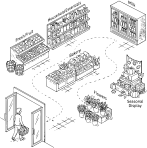
Most people know that supermarkets often place milk towards the back of the store.
The observation isn't where the milk is.
The observation is that the journey was designed.
The supermarket isn't forcing you to walk further.
It's arranging the environment so that one route feels obvious.
Every aisle prepares the next.
Every display influences what you notice.
Every step creates another opportunity.
Without realising it, you've travelled through a carefully designed experience.
Nobody Starts At The Checkout
Think about the last important purchase you made.
Did you decide instantly?
Probably not.
You explored.
Compared.
Read reviews.
Asked questions.
Looked for reassurance.
Only then did you make a decision.
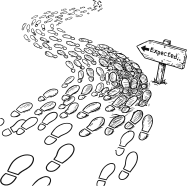
Businesses often expect customers to move directly from homepage to enquiry.
Real people rarely behave like that.
People don't simply arrive at decisions.
They travel towards them.
Businesses Design Journeys Too
It's easy to think customer journeys only exist in physical spaces.
They don't.
Every business creates them.
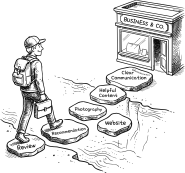
A visitor arrives on your homepage.
They read about your services.
They look at your portfolio.
They read your reviews.
They compare your work.
They check your FAQs.
They return a few days later.
Only then do they contact you.
That's normal.
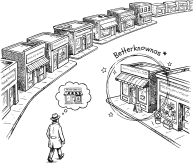
The question isn't whether your business has a customer journey.
The question is whether you've designed it intentionally.
Small Steps Build Big Decisions
Confidence rarely appears all at once.
It grows.
Customers understand what you do.
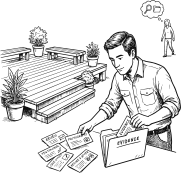
They see examples of your work.
They read testimonials.
They explore your process.
They begin to trust you.
Each small step removes a little uncertainty.
Each answer prepares them for the next question.
Progress isn't usually one giant leap.
It's a series of comfortable steps.
Friction Changes The Journey
Imagine visiting a supermarket where the milk moved to a different aisle every week.
There were no signs.
No obvious layout.
No logical flow.
Shopping would become frustrating.
The same thing happens online.
Confusing navigation.
Hidden contact forms.
Unclear pricing.
Broken links.
Too many choices.
Every unnecessary obstacle interrupts momentum.
Every unnecessary question creates another opportunity for someone to leave.
This Isn't About Manipulation
At this point it's easy to misunderstand the observation.
This article isn't suggesting businesses should trick customers into buying more.
It isn't arguing that longer journeys are better.
And it certainly isn't claiming every visitor should follow exactly the same path.
The observation is much simpler.
Thoughtful businesses make progress feel natural.
They answer questions at the right time.
They remove unnecessary friction.
They help customers continue with confidence.
Every Step Teaches Something
Every stage of your customer journey communicates something.
Your homepage.
Your navigation.
Your photography.
Your reviews.
Your case studies.
Your enquiry form.
Your emails.
Your proposal.
Every interaction either increases confidence...
Or introduces doubt.
Customers don't simply remember individual moments.
They remember how the journey felt.
The Better Question
Instead of asking:
"How can we get more enquiries?"
Perhaps ask:
"Where does confidence increase during our customer journey... and where does it quietly disappear?"
Because customers rarely arrive ready to buy.
They arrive ready to learn.
The easier it is to keep moving forward, the easier every decision becomes.
What This Doesn't Mean
This article isn't suggesting every business should copy supermarket layouts.
It isn't arguing that customer journeys should become longer.
And it isn't claiming every customer behaves in exactly the same way.
The observation is much simpler.
Every business shapes behaviour through the experiences it creates.
The best businesses don't simply design destinations.
They design journeys that make progress feel effortless.
The next time you buy a bottle of milk, don't just notice what ends up in your basket.
Notice where your feet took you first.
The journey wasn't accidental.
Neither is the journey through your business.
That's the real observation.
Customers don't simply arrive at decisions.
They travel towards them.
And every step either builds confidence...
Or quietly encourages them to turn back.