Why Repetition Shapes Reputation
Created by Better Known As*
July 2, 2026
8 minute read
Think about someone you've known for years.
You probably wouldn't describe them based on a single conversation.
Or one good day.
Or one mistake.
Instead, your opinion comes from something much quieter.
Patterns.
The more often someone behaves in a particular way, the more confident you become that the behaviour reflects who they really are.
We instinctively do exactly the same thing with businesses.
One Experience Is An Event
Imagine visiting a café for the first time.
The coffee is excellent.
The staff are friendly.
Everything feels welcoming.
You leave with a positive impression.
But you probably wouldn't say:
"They're always brilliant."
One experience creates an impression.
Not a reputation.
Repetition Changes What We Believe
Now imagine returning every week for six months.
Every visit is consistently good.
The coffee is excellent.
The staff remember your name.
The service is reliable.
Something begins to change.
You stop thinking about individual visits.
Instead, you form a belief.
"They're always good."
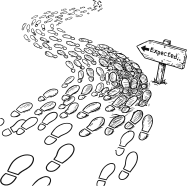
Repeated experiences become expectations.
The Brain Learns Through Reinforcement
Our brains constantly look for patterns.
Every repeated experience strengthens a prediction.
If the same outcome happens often enough, we begin expecting it to happen again.
Psychologists call this reinforcement.
Not because behaviour is forced.
But because repetition gradually increases our confidence that something is true.
Reputation Is Reinforced, Not Declared
This explains why reputation cannot simply be announced.
A business can describe itself as reliable.
Professional.
Friendly.
Experienced.
But those words only become believable when customers repeatedly experience them.
Reputation doesn't grow because of what a business claims.
It grows because customers repeatedly encounter evidence that supports the same conclusion.
Why Consistency Matters
Many businesses underestimate ordinary moments.
Answering the phone.
Replying to emails.
Arriving when promised.
Following up afterwards.
Each interaction seems insignificant on its own.
Together, they teach customers what to expect.
Consistency isn't about repeating marketing.
It's about repeating experiences.
The Betterknownas* Perspective
Businesses don't control what customers believe.
They influence it through repeated behaviour.
Every positive interaction quietly reinforces the same story.
Every inconsistency introduces uncertainty.
Over time, customers stop remembering individual experiences.
They remember the pattern those experiences created.
The strongest reputations are rarely built by extraordinary moments.
They're built by ordinary moments repeated often enough to become expected.
Because people don't trust what happens once.
They trust what keeps happening.