Why Busy Restaurants Feel Safer
Created by Better Known As*
June 27, 2026
14 minute read
Imagine you've been walking around a town you've never visited before.
It's lunchtime.
You're hungry.
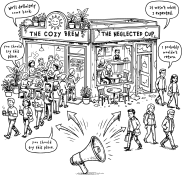
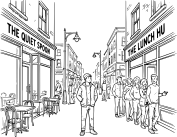
Two restaurants sit opposite each other on the same street.
One has empty tables.
The other has people chatting outside while they wait to be seated.
Nobody tells you which restaurant is better.
You haven't looked at the menu.
You haven't checked the reviews.
You know almost nothing about either business.
Yet one of them already feels like the safer choice.
That's an interesting observation.
Because this isn't really an article about restaurants.
It's an article about evidence.
Busy restaurants simply give us one of the clearest examples of how visible evidence quietly shapes our decisions.
The Observation Isn't The Queue
Most people notice that busy restaurants attract more customers.
The observation isn't that people like queues.
The observation is why other people's decisions influence our own.
When we see lots of people making the same choice, we instinctively wonder:
"What do they know that I don't?"
The queue doesn't prove the restaurant is better.
But it does reduce uncertainty.
Sometimes, that's enough.
Confidence Is Contagious
When we're uncertain, we naturally look for clues.
A busy café.
A full car park.
A waiting list.
Positive reviews.
Recommendations from friends.
Awards on the wall.
Completed projects.
Customer testimonials.
None of these guarantees quality.
But each one quietly tells us the same thing.
Other people felt confident enough to choose.
Confidence spreads remarkably easily.
Not because people copy each other blindly.
Because visible confidence reduces invisible risk.
Evidence Speaks More Loudly Than Claims
Imagine one restaurant displaying a large sign saying:
"The Best Restaurant In Town."
Across the road, another restaurant says nothing at all.
It simply has people waiting outside.
Which feels more convincing?
The sign is making a claim.
The queue is providing evidence.
Claims ask people to trust you.
Evidence helps people trust themselves.
People rarely trust confidence.
They trust evidence.
Businesses Often Say "Trust Us"
Many businesses proudly tell customers they're reliable.
Experienced.
Professional.
Trusted.
Friendly.
Those words aren't evidence.
They're conclusions.
Customers should arrive at those conclusions for themselves.
Great businesses don't simply ask people to trust them.
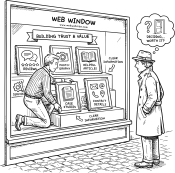
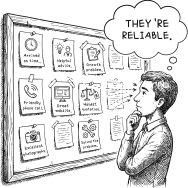
They make trust visible.
Reviews.
Case studies.
Recommendations.
Project photography.
Before-and-after images.
Testimonials.
Proof quietly answers questions before customers even think to ask them.
Evidence Reduces Mental Effort
Imagine choosing between two local electricians.
One has no reviews.
No photographs.
No examples of previous work.
The other has dozens of verified reviews, completed projects and happy customers willing to recommend them.
Which one feels easier to contact?
Not necessarily because they're more skilled.
Because they require less faith.
Evidence doesn't tell people what to think.
It helps them feel safe enough to decide.
This Isn't About Following Crowds
At this point it's easy to misunderstand the observation.
This article isn't suggesting busy businesses are always better.
It isn't arguing that popularity guarantees quality.
And it certainly isn't encouraging businesses to manufacture artificial demand.
The observation is much simpler.
When people don't have complete information, they naturally look for evidence.
Other people's experiences often become part of that evidence.
Every Customer Leaves Evidence Behind
Every completed project creates something valuable.
Not just revenue.
Evidence.
A review.
A testimonial.
A recommendation.
A photograph.
A case study.
Every satisfied customer makes the next customer's decision a little easier.
Trust grows because evidence accumulates.
The Better Question
Instead of asking:
"How can we persuade more people?"
Perhaps ask:
"If somebody discovered our business today... what proof would they find before they found our promises?"
Because customers rarely expect certainty.
They simply want enough evidence to feel comfortable taking the next step.
What This Doesn't Mean
This article isn't suggesting businesses should chase popularity.
It isn't arguing that reviews matter more than delivering excellent work.
And it isn't claiming people should blindly follow crowds.
The observation is much simpler.
Customers often make decisions with incomplete information.
Visible evidence helps them reduce uncertainty.
The strongest businesses don't simply make promises.
They make proof easy to discover.
The next time you walk past a busy restaurant, don't look at the menu.
Look at the people.
They're not simply waiting for lunch.
They're quietly becoming part of the restaurant's reputation.
That's the real observation.
Customers don't simply evaluate businesses.
They observe other customers.
Sometimes...
That's all the evidence they need to feel confident taking the next step.
And that's why proof will almost always persuade more effectively than promises.