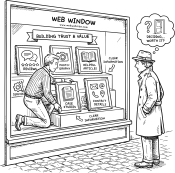
Build A Website That Builds Trust
Created by Better Known As*
June 29, 2026
16 minute read
Your website is often the first real experience someone has of your business.
Long before they send an enquiry.
Long before they pick up the phone.
Long before they decide whether you're the right choice.
That first impression matters.
Not because your website needs to impress people.
Because it needs to answer their questions.
This playbook will help you review your website through the eyes of a first-time visitor and identify practical improvements that make your business easier to understand, easier to trust and easier to choose.
Step 1 — Experience Your Website As A Customer
Open your homepage.
Now imagine you've never heard of your business before.
Within thirty seconds, ask yourself:
- What does this business do?
- Who is it for?
- Why should I choose them?
- What should I do next?
If any answer feels unclear, your visitors are probably asking the same questions.
Clarity creates confidence.
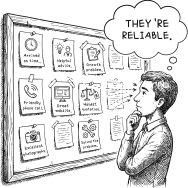
Step 2 — Look For Evidence
Customers don't simply believe what businesses claim.
They look for proof.
Review your website.
What evidence does it provide?
Examples include:
- Customer reviews.
- Project photography.
- Case studies.
- Helpful articles.
- Industry experience.
- Clear explanations.
- Frequently asked questions.
Every piece of evidence removes another question.
Every missing piece creates uncertainty.
Step 3 — Review Every Page
Every page contributes to the impression your business creates.
Review each one individually.
Ask yourself:
- Does this page have a clear purpose?
- Does it answer the questions a visitor is likely to have?
- Does it reinforce the reputation we want to build?
- Is there a clear next step?
Pages shouldn't exist simply because every website has one.
Every page should earn its place.
Step 4 — Remove Friction
Imagine somebody is ready to contact you.
How easy have you made it?
Review your website for unnecessary obstacles.
Examples might include:
- confusing navigation,
- outdated information,
- difficult contact forms,
- slow loading pages,
- missing service information,
- unclear calls to action.
Small frustrations often create unnecessary doubt.
The strongest websites make progress feel effortless.
Step 5 — Keep Your Website Alive
Many businesses treat their website as a finished project.
The strongest businesses treat it as a living asset.
Ask yourself:
- Have we added recent work?
- Have we published helpful content?
- Are our reviews current?
- Does our photography reflect today's business?
- Are we answering the questions customers ask most often?
Every improvement strengthens your reputation.
Every update prepares your business for future opportunities.
Step 6 — Prioritise Improvements
Don't try to rebuild everything.
Start with the changes that will have the greatest impact.
Ask yourself:
- Which page creates the weakest first impression?
- Which question remains unanswered?
- Which improvement would make contacting us feel easier?
Choose one action for this week.
One for this month.
One for this quarter.
Progress is more valuable than perfection.
Your Website Plan
Complete the statements below.
The strongest page on our website is...
The biggest question our website doesn't answer is...
The greatest opportunity to improve confidence is...
The first improvement we'll make is...
Keep reviewing these answers.
A website should evolve as your business evolves.
Playbook Summary
Before moving on, make sure you have:
- Reviewed your website from a customer's perspective.
- Identified unanswered questions.
- Audited your evidence.
- Reviewed every important page.
- Removed unnecessary friction.
- Created a practical improvement plan.
A great website isn't the one with the most impressive design.
It's the one that helps people understand your business.
It answers their questions.
It demonstrates your experience.
It reinforces your reputation.
It removes unnecessary doubt.
Because the best websites don't simply attract visitors.
They quietly help future customers feel confident enough to become enquiries.