Why Apple Rarely Needs To Explain Itself
Created by Better Known As*
June 7, 2026
13 minute read
Imagine you're sitting in a café.
Someone sits opposite you and places a closed laptop on the table.
It hasn't been opened.
Nobody has mentioned its specifications.
You haven't seen what it can do.
Then you notice the logo.
Almost immediately, assumptions begin to form.
Perhaps you think:
Creative.
Premium.
Well designed.
Simple.
Whether you personally agree with those descriptions isn't the interesting part.
The interesting part is that they appeared before anyone explained anything.
The laptop hasn't changed.
Only your expectations have.
How can a single logo communicate so much without saying a word?
This isn't really an article about Apple.
It's an article about how businesses acquire meaning.
Apple simply gives us a useful way to observe it.
The Observation Isn't The Logo
Most people already recognise the Apple logo.
That's not surprising.
The more interesting question is this:
Why does the logo no longer need much explanation?
The answer isn't hidden inside the logo itself.
It's hidden inside years of accumulated experience.
People aren't responding to a symbol.
They're responding to everything that symbol has gradually come to represent.
Meaning Doesn't Arrive Overnight
Many people think brands create meaning through advertising.
Advertising can certainly introduce ideas.
But it rarely creates lasting meaning on its own.
Meaning grows much more slowly.
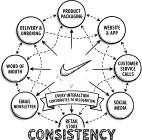
Every interaction teaches people something.
A product.
A website.
A recommendation.
A visit to a shop.
An advert.
A conversation.
Customer support.
Packaging.
None of those experiences changes everything.
Together they change almost everything.
Meaning isn't announced.
It's accumulated.
Every Experience Is Teaching Something
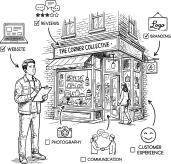
Whether you realise it or not, your business is teaching people every day.
Your website teaches.
Your branding teaches.
Your photography teaches.
Your reviews teach.
Your quotations teach.
Your invoices teach.
The way you answer the phone teaches.
The way you solve problems teaches.
Customers are constantly learning what your business means.
The question isn't whether you're teaching.
The question is:
What are people learning?
Meaning Becomes Expectation
One of the most fascinating things about strong brands is how quickly they shape expectations.
Long before someone uses a product, they often expect a particular experience.
Not because somebody recently explained it.
Because previous experiences have already done the explaining.
Those experiences might be personal.
They might come from friends.
From family.
From the media.
Or simply from repeated exposure over many years.
Eventually, expectations become automatic.
Meaning reduces the amount of explanation that's needed.
Consistency Allows Meaning To Grow
Imagine if every Apple product looked completely different.
Every advert felt unrelated.
Every retail store created a different impression.
Every interaction told a different story.
The meaning attached to the brand would become much weaker.
Not because the products had changed.
Because consistency had disappeared.
Consistency allows meaning to accumulate instead of constantly starting again.
Every familiar experience strengthens the story people already believe.
Meaning Is Remembered Experience
Businesses often talk about values.
Customers rarely remember value statements.
They remember experiences.
Helpful.
Reliable.
Creative.
Professional.
Friendly.
Honest.
Those aren't marketing messages.
They're conclusions.
People arrive at them after repeatedly experiencing the same business.
Meaning isn't what a business says about itself.
It's what customers gradually come to believe.
Small Businesses Build Meaning Too
It's easy to assume this only applies to global brands.
It doesn't.
Think about your favourite local café.
Your trusted electrician.
Your regular barber.
The plumber you always recommend.
What comes to mind?
Reliable?
Friendly?
Fair?
Experienced?
Those ideas weren't created by a logo.
They were earned through repeated experience.
The psychology is identical.
Only the scale is different.
What This Doesn't Mean
This article isn't suggesting every business should copy Apple.
It isn't claiming logos are magical.
And it isn't arguing that appearance matters more than service.
The observation is much simpler.
Every business is teaching customers what it means.
Some do it deliberately.
Others do it accidentally.
Either way, meaning is being built.
The Better Question
Instead of asking:
"How can we explain our business more clearly?"
Perhaps ask:
"What have our customers already learned about us?"
Because every interaction leaves behind a lesson.
Every lesson contributes to meaning.
And every layer of meaning changes how future communication is received.
Tomorrow you'll see hundreds of logos.
Most will disappear before lunchtime.
A handful won't.
Not because they're better designed.
Not because they're larger.
Not even because you've used them.
Because over time they've come to mean something.
That's the real observation.
Logos don't carry meaning.
People give it to them.
One experience at a time.