Why We See Patterns Before We See Brands
Created by Better Known As*
June 8, 2026
8 minute read
Imagine visiting the same café every Saturday morning.
The coffee is consistently good.
The staff greet you with a smile.
Your order arrives exactly as you expect.
After a while, something changes.
You stop judging each visit individually.
You simply think:
"They're always good."
You haven't memorised every experience.
You've recognised a pattern.
Our Brains Are Built To Find Patterns
Human beings naturally look for regularity.
We notice repetition.
We connect similar experiences.
We predict what is likely to happen next.
It's one of the brain's simplest and most useful shortcuts.
Rather than remembering hundreds of individual moments, we combine them into a single expectation.
Businesses Become Patterns
Customers rarely remember every phone call.
Every email.
Every project.
Instead, they remember the overall experience.
Reliable.
Helpful.
Friendly.
Professional.
Or perhaps...
Difficult to reach.
Slow to respond.
The individual moments fade.
The pattern remains.
Patterns Reduce Uncertainty
Patterns help us make decisions more quickly.
If a business has consistently delivered a positive experience, we naturally expect the next experience to be similar.
That expectation reduces uncertainty.
It makes choosing feel easier.
Pattern recognition doesn't guarantee trust.
But it creates the conditions in which trust can grow.
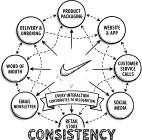
Every Interaction Either Strengthens Or Weakens The Pattern
No single interaction defines a business.
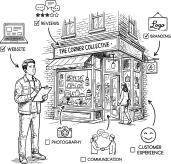
But every interaction contributes to the pattern customers are building.
A promise kept.
A helpful conversation.
A clear website.
A thoughtful follow-up.
Each one quietly reinforces the same story.
Inconsistency does the opposite.
It makes the pattern harder to recognise.
The Betterknownas* Perspective
Businesses often focus on creating memorable moments.
Those moments matter.
But lasting reputation usually comes from something much simpler.
Consistency.
Every repeated experience teaches customers what to expect.
Over time, customers stop remembering individual interactions.
They remember the pattern those interactions created.
People don't build confidence from isolated moments.
They build it from patterns repeated often enough to feel predictable.
Because before a business becomes trusted...
It first becomes understood.