Why Airport Signs Never Try To Be Clever
Created by Better Known As*
June 17, 2026
13 minute read
Imagine you've just stepped off a long flight.
You're tired.
You're carrying luggage.
Your phone battery is almost flat.
You've never visited this airport before.
You need to find passport control.
What's the last thing you want?
A clever sign.
You don't want a slogan.
You don't want a joke.
You don't want somebody trying to impress you.
You simply want to know where to go next.
That's an interesting observation.
Because this isn't really an article about airports.
It's an article about communication.
Airports simply provide one of the clearest examples of what effective communication actually looks like.
The Observation Isn't The Sign
Most people barely remember airport signs.
That's exactly the point.
The observation isn't that airport signs are simple.
The observation is why simplicity matters.
Their purpose isn't to attract attention.
It's to remove uncertainty.
Every sign quietly answers one question.
"Where do I go next?"
Nothing more.
Nothing less.
Airports don't optimise for admiration.
They optimise for movement.
Clarity Removes Friction
Imagine if airport signs tried to be creative.
Instead of Baggage Reclaim, imagine a sign that read:
"Where Suitcases Find Their Way Home."
It's imaginative.
It might even make people smile.
But it also creates hesitation.
Is this where I collect my luggage?
Or is it something else?
That tiny pause matters.
Every unnecessary thought slows people down.
Good communication doesn't try to be admired.
It tries to be understood.
Consistency Builds Confidence
Walk through almost any airport in the world.
The architecture changes.
The language changes.
The size changes.
But the principles remain remarkably consistent.
Clear arrows.
Simple wording.
Recognisable symbols.
Predictable layouts.
Each sign quietly prepares you for the next.
You never have to learn a new system halfway through your journey.
Consistency reduces effort.
And reducing effort builds confidence.
Confidence Comes From Knowing What Happens Next
One of the reasons airports feel manageable—even when they're busy—is because they constantly reassure you.
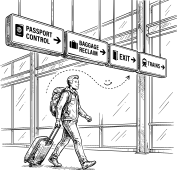
You've reached passport control.
Now follow the signs for baggage reclaim.
Now the exit.
Now taxis.
Now trains.
Every sign quietly says:
"You're still going the right way."
Businesses should do exactly the same.
Customers don't simply need information.
They need confidence that they're making progress.
The easier it is to understand what happens next, the easier it is to keep moving forward.
Businesses Often Make The Opposite Mistake
Many businesses believe every piece of communication should stand out.
So they rename familiar pages.
They invent clever headlines.
They hide contact forms behind creative wording.
They replace simple instructions with marketing language.
Not because customers asked for it.
Because they wanted to sound different.
The irony?
Customers rarely reward businesses for making them think harder.
They reward businesses that make life easier.
Good communication isn't measured by how original it sounds.
It's measured by how easily people understand it.
People Want Progress, Not Puzzles
When someone visits your website, they aren't there to admire your navigation.
They're trying to solve a problem.
They want to know:
- Can you help me?
- Can I trust you?
- What do you do?
- What should I do next?
Every unnecessary moment of confusion slows that journey.
Every clear answer builds confidence.
The clearest message is often the one nobody notices.
Because it quietly helped somebody continue.
This Isn't About Being Boring
At this point it's easy to misunderstand the observation.
This article isn't suggesting businesses should stop being creative.
It isn't arguing that branding should become plain.
And it certainly isn't claiming every headline should sound identical.
The observation is much simpler.
Creativity should support understanding.
Never compete with it.
The best communication has personality.
But it never leaves people wondering what happens next.
Every Interaction Should Reduce Uncertainty
Think about every part of your business.
Your homepage.
Your service pages.
Your navigation.
Your emails.
Your quotations.
Your proposals.
Your invoices.
Your signage.
Each one is either reducing uncertainty...
Or creating it.
The businesses that feel easiest to trust aren't always the loudest.
They're often the ones that quietly answer questions before customers need to ask them.
The Better Question
Instead of asking:
"How can we make this sound more creative?"
Perhaps ask:
"How can we make this easier to understand?"
Because every unnecessary moment of confusion is another opportunity for someone to hesitate.
And hesitation rarely helps people move forward.
What This Doesn't Mean
This article isn't suggesting businesses should stop being creative.
It isn't arguing that branding should become functional at the expense of personality.
And it isn't claiming originality has no value.
The observation is much simpler.
The most effective communication helps people move forward with confidence.
Great creativity doesn't create confusion.
It removes it.
The next time you walk through an airport, pay attention to what you don't notice.
The signs.
They won't ask for your attention.
They won't try to entertain you.
They won't compete to be remembered.
They'll simply help you reach your destination.
That's the real observation.
The best communication rarely becomes the story.
It quietly helps people continue theirs.
And that's exactly what great businesses should do.