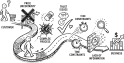
Why Evidence Creates Confidence
Created by Better Known As*
June 18, 2026
8 minute read
Imagine booking a hotel you've never visited.
Before you click Book Now, you probably do a few small things.
You look at the photographs.
You read a handful of reviews.
You check where it's located.
You browse the website.
None of those things proves the hotel will be perfect.
But together, they make the decision feel easier.
That's how confidence usually works.
It isn't created by one convincing moment.
It grows through accumulated evidence.
Every Decision Begins With Questions
Whenever we encounter something unfamiliar, our minds naturally begin asking questions.
Can I trust them?
Will they do what they promise?
Will this be worth the money?
Will they understand what I need?
We rarely expect complete certainty.
We're simply looking for enough evidence to move forward.
Small Signals Matter
Confidence rarely comes from dramatic claims.
It grows through small, reassuring signals.
A professional website.
Clear communication.
Authentic photography.
Helpful content.
Recent reviews.
A recommendation from someone we trust.
Each signal answers another small question.
On its own, it may seem insignificant.
Together, they create confidence.
Evidence Reduces Uncertainty
Notice what these signals have in common.
None of them asks the customer to trust blindly.
Instead, they reduce uncertainty.
The more questions that are answered...
The fewer reasons remain to hesitate.
Confidence doesn't appear all at once.
It gradually replaces doubt.
Confidence Comes Before Trust
We often talk about trust as though it appears instantly.
In reality, confidence usually comes first.
Customers begin believing a business is likely to deliver.
Only then does trust begin to emerge.
Confidence is the bridge between uncertainty and trust.
The Betterknownas* Perspective
Every interaction your business creates leaves evidence behind.
Every email.
Every photograph.
Every review.
Every recommendation.
Every helpful conversation.
Customers quietly gather those pieces together.
Not because they're trying to prove your business is perfect.
Because they're deciding whether moving forward feels safe.
Customers don't usually make decisions because of one extraordinary piece of evidence.
They make them because enough ordinary evidence quietly points in the same direction.
Confidence isn't built through persuasion.
It's built through accumulated reassurance.