Why McDonald's Looks Familiar Everywhere
Created by Better Known As*
June 22, 2026
14 minute read
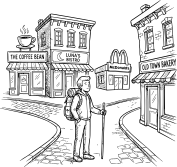
Imagine you've been driving for hours.
It's raining.
Your children are hungry.
You're somewhere you've never visited before.
You don't recognise any of the local restaurants.
Then you see the golden arches.
You haven't looked at the menu.
You haven't checked the reviews.
You haven't compared the alternatives.
Yet something changes.
The decision suddenly feels easier.
That's an interesting observation.
Because this isn't really an article about McDonald's.
It's an article about consistency.
McDonald's simply gives us one of the clearest examples of how familiar experiences quietly create confidence.
The Observation Isn't The Restaurant
Most people recognise McDonald's.
That's hardly surprising.
The observation isn't that McDonald's is everywhere.
The observation is why familiarity feels reassuring.
People aren't always searching for the best possible option.
Sometimes they're searching for the option that feels safest.
Not because they know everything.
Because they already know enough.
Predictability Reduces Uncertainty
Imagine choosing between two restaurants.
One you've never seen before.
One you already understand.
Which feels easier to choose?
Not because you know it's better.
Because you already know what to expect.
Predictability reduces uncertainty.
Customers don't always need certainty that something is perfect.
They often need confidence that it won't disappoint.
Consistency doesn't make businesses predictable.
It makes customers confident.
Consistency Builds Confidence
One visit doesn't create trust.
Neither do two.
Confidence grows through repetition.
Every familiar menu.
Every recognisable package.
Every similar layout.
Every predictable interaction.
Each experience quietly reinforces the last.
Customers stop wondering what might happen.
Because experience has already answered that question.
That's how confidence grows.
Familiar Doesn't Mean Boring
One of the biggest misunderstandings about consistency is that it somehow limits creativity.
It doesn't.
Think about some of the world's most recognisable brands.
Apple.
Nike.
LEGO.
McDonald's.
Each is highly consistent.
None feels boring.
Consistency creates the confidence that allows creativity to flourish.
Customers appreciate originality.
But only after they understand who you are.
Businesses Often Chase Novelty
Many businesses redesign their website every few years.
Rewrite their messaging.
Change their logo.
Rename their services.
Introduce new terminology.
Not because customers were confused.
Because the business became bored.
Customers don't experience your business every day.
You do.
That's an important difference.
The things that feel repetitive to you often feel reassuringly familiar to everyone else.
Trust Comes From Knowing What Happens Next
Think about your favourite café.
The barber you've visited for years.
The mechanic you always recommend.
Why do you keep going back?
Partly because the quality is good.
But also because you already understand the experience.
You know how you'll be greeted.
You know how they work.
You know what to expect.
Trust often grows because uncertainty gradually disappears.
This Isn't About Fast Food
At this point it's easy to misunderstand the observation.
This article isn't suggesting every business should copy McDonald's.
It isn't claiming consistency matters more than quality.
And it certainly isn't arguing that businesses should stop improving.
The observation is much simpler.
Customers value businesses that consistently deliver on their promises.
Whether you're a local plumber, accountant, designer or café owner, the principle remains exactly the same.
People return to experiences they trust.
Every Interaction Reinforces Expectations
Every interaction teaches customers something.
Your website.
Your branding.
Your emails.
Your quotations.
Your photography.
Your customer service.
Your finished work.
Each one quietly reinforces an expectation.
The question isn't whether customers are learning.
The question is:
What are they learning to expect?
Because today's experience shapes tomorrow's confidence.
The Better Question
Instead of asking:
"How can we make this different?"
Perhaps ask:
"If our best customer returned in six months... would the experience still feel reassuringly familiar?"
Because confidence rarely comes from surprise.
It usually comes from consistency.
What This Doesn't Mean
This article isn't arguing that businesses should never change.
It isn't suggesting innovation should stop.
And it isn't claiming customers dislike originality.
The observation is much simpler.
Customers don't want uncertainty where certainty matters.
They want confidence that your business will consistently deliver what it promises.
Great businesses evolve.
But they do so without making customers feel lost.
The next time you travel somewhere unfamiliar, notice what makes you feel comfortable.
It probably won't be the newest building.
Or the cleverest branding.
Or the biggest advertisement.
It will be the thing you already understand.
That's the real observation.
Trust isn't created because customers know everything.
It's created because they already know enough.
Businesses don't earn confidence by constantly changing.
They earn it by consistently delivering experiences people recognise.
And that's what makes familiar businesses feel reassuring wherever we find them.